module Algebra.Group.Homotopy where
Homotopy groups🔗
Given a pointed type
we refer to the type
as the loop space of
,
and refer to it in short as
Since we always have
is itself a pointed type, the construction can be iterated, a
process which we denote
Ωⁿ : Nat → Type∙ ℓ → Type∙ ℓ
Ωⁿ zero A    = A
Ωⁿ (suc n) (A , x) with Ωⁿ n (A , x)
... | (T , x) = Path T x x , refl
For positive
we can give
a Group structure, obtained by truncating the higher
groupoid structure that
is equipped with. We call the sequence
the homotopy groups of
but remark that the indexing used by πₙ₊₁ is off by 1:
πₙ₊₁ 0 A is the fundamental group
πₙ₊₁ : Nat → Type∙ ℓ → Group ℓ
πₙ₊₁ n t = to-group omega where
  omega : make-group ∥ Ωⁿ (suc n) t .fst ∥₀
  omega .make-group.group-is-set = squash
  omega .make-group.unit = inc refl
  omega .make-group.mul = ∥-∥₀-map₂ _∙_
  omega .make-group.inv = ∥-∥₀-map sym
As mentioned above, the group structure is given entirely by the
groupoid structure of types: The neutral element is refl, the group operation is
path concatenation,
and the inverses are given by inverting paths.
  omega .make-group.assoc = elim! λ x y z i → inc (∙-assoc x y z i)
  omega .make-group.invl = elim! λ x i → inc (∙-invl x i)
  omega .make-group.idl = elim! λ x i → inc (∙-idl x i)
A direct cubical transcription of the Eckmann-Hilton argument tells us that path concatenation for is commutative, independent of
Ωⁿ⁺²-is-abelian-group
  : ∀ {ℓ} {A : Type∙ ℓ} (n : Nat) (p q : Ωⁿ (2 + n) A .fst)
  → p ∙ q ≡ q ∙ p
Ωⁿ⁺²-is-abelian-group n p q =
  transport
    (λ k → ap (λ x → ∙-idr x k) p ∙ ap (λ x → ∙-idl x k) q
         ≡ ap (λ x → ∙-idl x k) q ∙ ap (λ x → ∙-idr x k) p)
    (λ i → (λ j → p (j ∧ ~ i) ∙ q (j ∧ i))
         ∙ (λ j → p (~ i ∨ j) ∙ q (i ∨ j)))
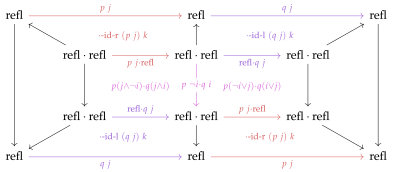
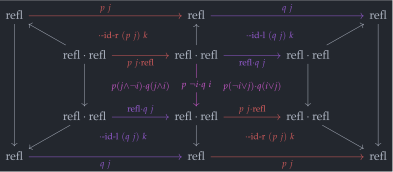
The proof can be visualized with the following diagram, where the
vertices are in
The outer rectangle shows p ∙ q ≡ q ∙ p, which is filled by
transporting the two inner squares using ∙-idr on p j and
∙-idl on q j. Note
that ∙-idr refl and ∙-idl refl are
definitionally equal. In the two inner squares, p j and
q j are on different sides of the path composition, so we
can use the De Morgan structure on the interval to have p
and q slip by each other.
Lifting this result through the set truncation establishes that is an Abelian group:
πₙ₊₂-is-abelian-group : ∀ {ℓ} {A : Type∙ ℓ} (n : Nat)
                      → Group-on-is-abelian (πₙ₊₁ (1 + n) A .snd)
πₙ₊₂-is-abelian-group {A = A} n =
  elim! λ x y i → inc (Ωⁿ⁺²-is-abelian-group n x y i)
We can give an alternative construction of the fundamental group for types that are known to be groupoids: in that case, we can avoid using a set truncation since the loop space is already a set.
module π₁Groupoid {ℓ} ((T , t) : Type∙ ℓ) (grpd : is-groupoid T) where
  private
    mk : make-group (t ≡ t)
    mk .make-group.group-is-set = grpd t t
    mk .make-group.unit         = refl
    mk .make-group.mul          = _∙_
    mk .make-group.inv          = sym
    mk .make-group.assoc        = ∙-assoc
    mk .make-group.invl         = ∙-invl
    mk .make-group.idl          = ∙-idl

  on-Ω : Group-on (t ≡ t)
  on-Ω = to-group-on mk

  π₁ : Group ℓ
  π₁ = to-group mk

  π₁≡π₀₊₁ : π₁ ≡ πₙ₊₁ 0 (T , t)
  π₁≡π₀₊₁ = ∫-Path
    (total-hom inc (record { pres-⋆ = λ _ _ → refl }))
    (∥-∥₀-idempotent (grpd _ _))